
To retire a cash advance, an employee accounts for every naira and settles whatever balance remains. Until that happens, the money sits on your books as a receivable, not an expense. Nobody can say whether it was spent well, returned or simply kept.
Most Nigerian finance teams know this routine. Many still run it on email threads and spreadsheets. Receipts arrive late, balances get argued over, and old advances pile up at month end.
This guide covers cash advance retirement from the request to the closed balance. It includes a worked example in naira. It also shows how to handle money returned or owed when the numbers do not match. The steps suit finance teams in Nigeria and across English-speaking Africa. They work with any accounting system.
What It Means to Retire a Cash Advance
A cash advance is money the company hands to an employee before the spending happens. It might pay for a trip, a site purchase or a vendor who only takes cash. The employee must then show where it went.
To retire a cash advance is to close that loop. The employee submits receipts for what was spent. Finance compares the total with the amount paid out. Any difference is returned or owed, and the advance is closed.
Nigerian company and university policies often call this step retirement. Some teams say they settle a cash advance instead. Both phrases mean the same thing.
A cash advance is not reimbursement. In reimbursement, the employee spends their own money first and claims it back. A cash advance works the other way round. The company pays first, and the employee proves the spending afterwards.
It is also not a salary advance. A salary advance is a loan repaid through payroll. A cash advance stays company money until it is spent on approved business costs.
What to Capture Before You Retire a Cash Advance
Good cash advance retirement starts at the request, not at the receipts. Each request should record four things.
- The business purpose, written clearly enough for an auditor to follow.
- The amount, with a short breakdown such as transport, lodging and meals.
- The approver, matched to an approval limit that covers that amount.
- The retirement deadline, counted in days from the pay-out.
Start the clock when Finance records the pay-out. Do not start it when the employee collects the cash. Also confirm the employee has no older advance still open. Blocking a second advance until the first is settled stops many late retirements.
How to Retire a Cash Advance in Six Steps
Use the same six steps for every advance. A fixed routine makes retiring an advance quick and easy to audit.
Each step has one owner. The employee supplies receipts and the report. The approver checks the spending against policy. Finance records the pay-out, the cash handed back and the journal. Splitting these roles keeps errors from going unnoticed.
Step 1: Record the pay-out and set the deadline
Finance records the pay-out against the employee. Include the date, the amount and the bank account used. Keep a separate ledger line per employee so every balance traces to one person. The full amount now shows as still to account for. Tell the employee the deadline in writing. Put the date in the approval message, not only in the policy.
Step 2: Collect receipts while the spending happens
Ask employees to photograph every receipt on the day. Handwritten and thermal receipts fade or get lost within weeks. Where no receipt exists, ask for a signed note. It should give the vendor, date and amount. Treat these notes as exceptions that need a manager’s sign-off.
Step 3: Apply advance to expense report
The employee enters each expense on an expense report. The next task is to apply advance to expense report entries, so approved spending offsets the advance. One advance can be applied across more than one report. The total applied can never exceed the amount paid out. Spending above that goes in as a normal claim.
Step 4: Review the report against policy
The approver checks each line against its receipt, category and business purpose. Finance looks for duplicates, such as the same merchant, date and amount twice. A rejection should state the reason. The employee needs to know exactly what to fix. Decide in your policy whether a rejection pauses the deadline.
Step 5: Work out the money returned or owed
Subtract the approved spending from the amount paid out. A positive result means the employee still holds company cash and must return it. A negative result means the company owes the employee. Zero means the advance closes cleanly. Record any cash handed back with the bank transfer reference or receipt number.
Step 6: Post the journal and close the advance
Finance reviews the journal entry before posting. Expense accounts are debited and the employee advance account is credited. Cash returned goes to the bank or cash account. Anything owed to the employee waits as a payable until it is paid. Close the advance only when the amount still to account for reaches zero.
Worked Example: How to Retire a Cash Advance of ₦250,000
A sales manager in Lagos asks for ₦250,000 for a customer visit in Port Harcourt. Her line manager approves the request. Finance pays it out on Monday.
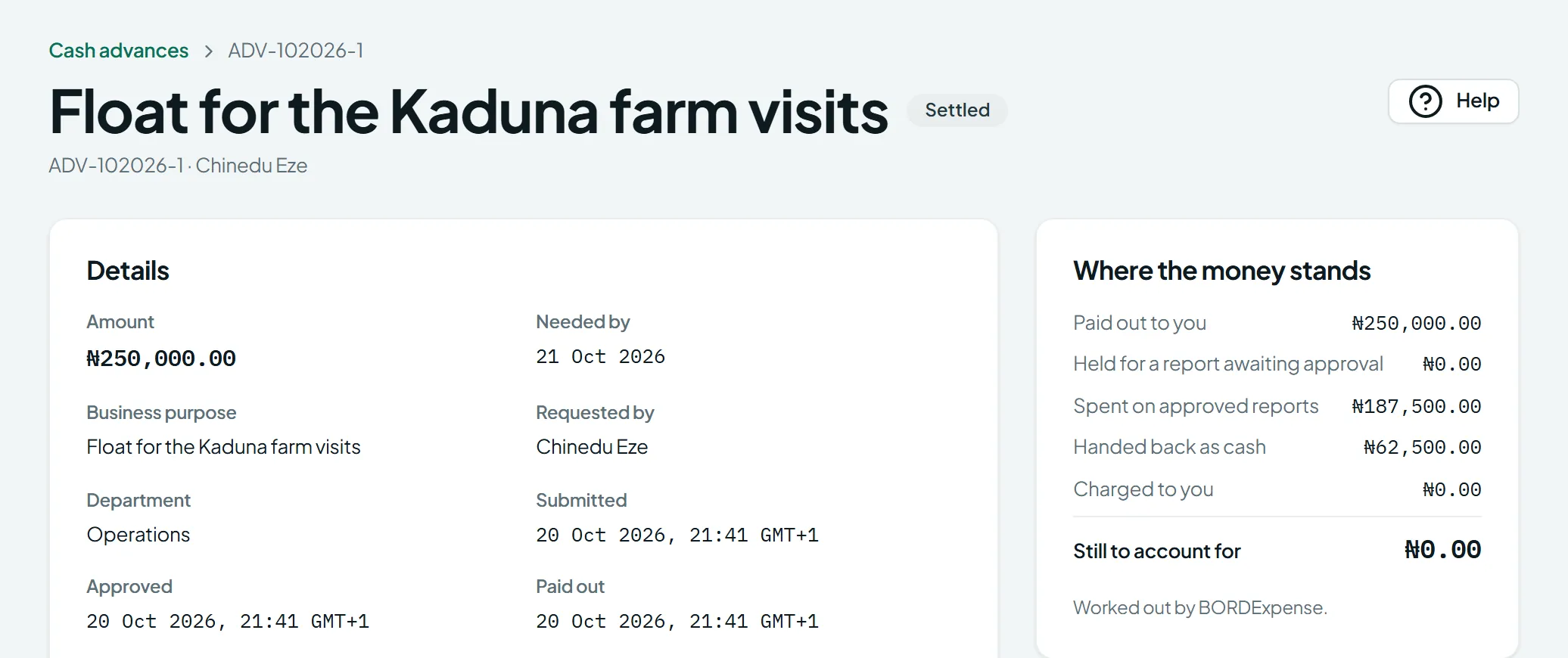
After the trip, she submits one expense report with hotel, transport and meals. She must apply advance to expense report entries before submitting, so the report shows what the advance already covers. The approved total is ₦187,500. She transfers the remaining ₦62,500 to the company account. Finance records the transfer with its reference.
| Event | Amount | Still to account for |
|---|---|---|
| Finance pays out the advance | ₦250,000 | ₦250,000 |
| Approved expense report applied to the advance | ₦187,500 | ₦62,500 |
| Employee returns unspent cash | ₦62,500 | ₦0 |
The last column is the one Finance watches. It starts at the full amount and falls with every approved expense or returned naira. When it reaches ₦0, the advance is retired.
Money Returned or Owed: The Three Ways a Cash Advance Ends
Every advance ends one of three ways. The test is the same each time. Compare approved spending with the amount paid out. The table uses the same ₦250,000 advance.
| Approved spending | Result | What Finance records |
|---|---|---|
| ₦187,500, below the advance | Employee returns ₦62,500 | Expenses debited, advance credited, cash returned to the bank account |
| ₦250,000, equal to the advance | Nothing owed either way | Expenses debited, advance credited, no cash moves |
| ₦281,000, above the advance | Company owes ₦31,000 | Advance fully applied, extra ₦31,000 held as a payable to the employee |
The third case catches teams out. The extra ₦31,000 is not a top-up of the advance. It is a claim, so it passes the same approvals and policy checks. Finance pays it through the normal payment process once approved.
Some policies let employees carry unspent cash into the next trip. We advise against it. It blurs the audit trail and hides old balances. Return the cash, then raise a new request.
Why Teams Struggle to Settle a Cash Advance on Time
Four problems slow down retiring an advance. Each has a simple fix.
- Late receipts. Employees wait until the trip ends. On long projects, ask for receipts every week.
- Partial retirement. Someone submits half the receipts and promises the rest. Retire what is proven and keep the balance open.
- Repeat advances. A new advance is paid while the last is still open. Block the request until the old one is settled.
- No owner. Nobody reviews the open list. Give one person in Finance a weekly review of advances past their deadline.
The longer an advance stays open, the harder it is to settle a cash advance fairly. Memories fade, receipts disappear, and staff move on.
What a Cash Advance Retirement Policy Should Say
Write the rules once, in plain language, and publish them with the request form. A short policy should cover five points.
- The retirement window, in days.
- The receipt rule, including the amount above which a receipt is compulsory.
- Who approves, and the limit for each approver.
- What happens after the deadline.
- How unspent cash is returned, and who confirms it.
The after-deadline rule is the sensitive one. Many organisations recover the balance from salary. If yours does, get written consent on the request form. Check the rule against your employment contracts and local labour law first. Employees who see the deadline when they ask are more likely to meet it.
Make It Routine to Retire a Cash Advance
To retire a cash advance cleanly, you need four things. They are a deadline, receipts, an expense report applied to the advance, and a clear balance. A spreadsheet can hold that for a handful of advances. It struggles with dozens, because nobody sees what is overdue.
BORDExpense was built for this part of the job. Retiring an advance should not mean weeks of chasing. The employee retires the advance on an expense report. Finance records any cash handed back. Each advance shows where the money stands, from the amount paid out to what is still to account for. You set the deadline, and anything left unretired comes to Finance. It works with or without Sage X3.
Request a demo of BORDExpense and bring your current cash advance policy. The team will show you the same steps on real screens.
Frequently Asked Questions About How to Retire a Cash Advance
What does it mean to retire a cash advance?
To retire a cash advance means to account for the money after it is spent. The employee submits receipts for what was spent. Finance compares them with the amount paid out. Unspent cash is returned, extra spending is reimbursed, and the advance is closed.
How long does an employee have to retire a cash advance?
Company policy sets the period, not a universal rule. Many policies allow between one and four weeks after the trip or purchase. Pick a number of days, publish it with the request form, and apply it to everyone.
What documents do you need to retire a cash advance?
You need the approved advance request, the original receipts and a completed expense report. Add the bank transfer confirmation if the employee returned cash. Where a receipt is missing, many policies accept a signed note approved by a manager as an exception.
What happens if an employee spends more than the cash advance?
The advance is applied in full to the expense report. The extra spending becomes a normal claim with the usual approvals. Once approved, Finance records the amount as owed to the employee and pays it through the normal payment process.
What happens if a cash advance is not retired on time?
The policy should state the steps. Common steps are a reminder, escalation to the line manager and a block on new advances. Some employers also recover the balance from salary, where the employee agreed in writing. Finance should review advances past their deadline every week.
Is cash advance retirement the same as reimbursement?
No. In reimbursement, the employee pays first and the company repays them. In cash advance retirement, the company pays first and the employee proves the spending afterwards. The two meet only when spending goes above the advance.
What is the journal entry when you retire a cash advance?
Paying the advance debits employee advances and credits the bank. To retire a cash advance, debit the expense accounts and credit employee advances. Returned cash debits the bank and credits employee advances. Any extra spending credits a payable to the employee.