
Expense management is how an organisation checks, approves and accounts for money its staff spend on its behalf. That covers travel, fuel, meals, supplier deposits and cash advances. It starts when an employee spends or asks for money. It ends when Finance posts the entry to the accounts.
Many finance teams in English-speaking Africa still do this work through email and spreadsheets. This guide explains the expense management definition, the process and the controls that matter. You will also see when a spreadsheet stops being enough.
What Is Expense Management? The Plain Definition
The expense management definition most finance teams use is simple. It is the set of rules and steps that control employee spending, from request to posting.
Four actions sit at the centre.
- Capture: the employee records the spend and attaches a receipt.
- Check: rules test the claim against company policy.
- Approve: the right manager signs off within their approval limit.
- Account: Finance posts the entry to the general ledger.
Expense management deals with spending that employees start themselves. A driver buys fuel on a long run. A sales manager pays for a hotel at a trade fair. A procurement officer needs cash for a vendor who takes no transfers.
It also covers cash advances. An advance is company money paid out before the spending happens. It stays on the books until the employee accounts for it.
Why Expense Management Matters for Finance Teams
Without expense management, every claim becomes a conversation. Claims arrive by email, receipts arrive as photos and advances live in a spreadsheet. Someone in Finance chases each receipt. Nobody can see which advances are still open.
Timing is the real problem. A missing receipt is easy to find on the day. It is hard to find six weeks later. Rules that run at submission catch the gap while the receipt is still in the employee’s bag.
Growth makes it worse. A routine that works for five staff breaks at fifty.
Good expense management gives a finance team four things.
- Control: spending follows the approval limits you set.
- Visibility: Finance sees what is waiting and what is overdue.
- Accuracy: each line lands on the right GL account and cost centre.
- Audit readiness: every change leaves a record.
The Expense Management Process Step by Step
The expense management process has the same shape in every organisation. Tools change, but the sequence does not.
- Set the policy. Decide what staff may claim, how much and by when. Keep it short enough that people read it.
- Capture the spend. The employee records the date, merchant, amount, category and business purpose. Receipts go on the report.
- Check at submission. Rules test the report before it moves on. A missing receipt stops it while the employee can still fix it.
- Approve within limits. The line manager approves first. A finance director joins above an amount you choose.
- Review the journal. Finance checks the GL account on each line and the debits and credits. It also sees what is due to the employee.
- Post to the accounts. Post by hand, download a CSV for your accounting system, or send it to your ERP.
- Report and review. Finance tracks late reports, open advances and spend by category or cost centre.
Cash advances add a loop to this flow. The company pays first, and the employee accounts for the money later.
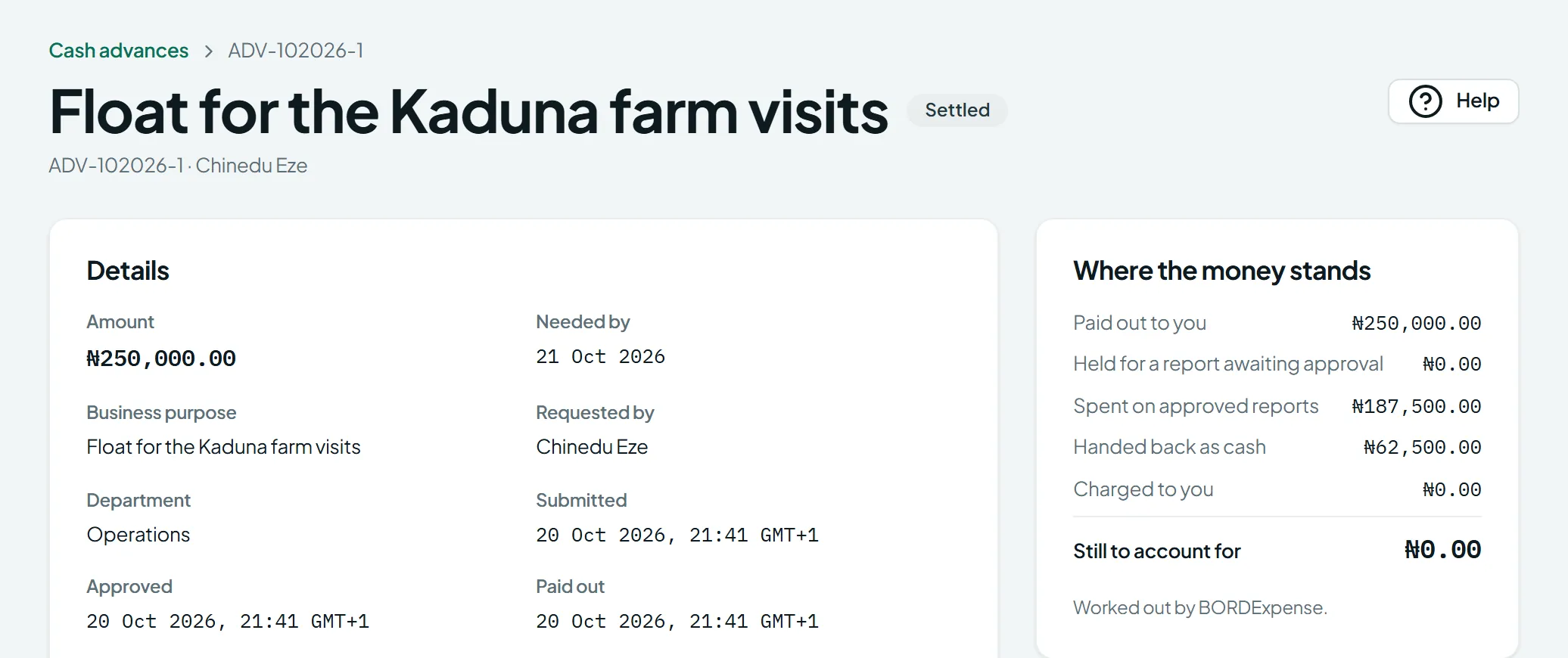
Take a ₦250,000 advance. The employee spends ₦187,500 on approved expenses and hands back ₦62,500 in cash. That leaves ₦0 to account for.
Our guide on how to retire a cash advance walks through each stage. The matching cash advance accounting entry guide shows the journals behind it.
Expense Management vs Spend Management and Related Terms
Finance teams hear four similar terms. They are not interchangeable, and vendors often blur them. This table separates them.
| Term | What it covers | Example | Usually owned by |
|---|---|---|---|
| Expense management | Spending that employees start, plus their cash advances | A sales manager’s trade fair trip to Lagos | Finance team |
| Spend management | All company spending, including suppliers and budgets | A yearly contract with a software vendor | Finance and procurement |
| Accounts payable | Supplier invoices and payment runs | An invoice for office furniture | AP clerk or Finance |
| Cost management | Planning and reducing the cost of the business or a project | A plan to cut logistics costs this year | Management and Finance |
Most vendors describe expense management as one layer of spend management. Spend management is the wider frame. Expense management is the layer employees touch every week.
Some writers also treat cost management as a separate discipline. Agree the terms with your auditor before you brief a vendor.
Spending Rules That Make Expense Management Work
A written policy does little on its own. Good expense management turns policy into checks that run for you. A rule can stop a report until it is fixed. It can also flag a line for the approver to see.
The table below shows five rules with example settings in naira. Set yours from your own policy.
| Rule | Example setting | What happens |
|---|---|---|
| Receipt required | Any expense above ₦20,000 | The report is held until a receipt is attached |
| Business purpose | Every expense line | The employee is told which line is blank |
| Age limit | Expenses older than 30 days | The line is flagged for the approver |
| Duplicate check | Same merchant, date and amount twice on one report | The line is flagged before approval |
| Approval limit | Finance director above ₦500,000 | The report routes to the right approver |
BORDExpense runs rules like these through its approval steps and spending rules. They run when the employee submits, so the fix happens early.
Keep three roles apart. One person spends, another approves and a third posts. Employees should see only their own records. Approvers should receive only what falls within their limit. Every change should land in an audit trail that no one can edit.
Advances need their own written rules. Our guide to a cash advance policy for business expenses lists the clauses to include. It covers eligibility, approval limits and the settlement due date.
Expense Management for Finance Teams: Spreadsheets or Software?
Expense management for finance teams of one to five people often starts in a spreadsheet. That works for a while. Ten claims a month fit in one workbook. Two hundred claims and a dozen open advances do not.
Watch for these signs that the spreadsheet has stopped working.
- Nobody can say which advances are overdue without opening three files.
- Receipts are chased by phone after the month has closed.
- An approver signs a claim above their limit because nothing checks it.
- Finance re-keys approved claims into the accounting system by hand.
- A changed cell leaves no record of who changed it.
Software moves the rules into the workflow. BORDExpense is built for this stage, for organisations of about 20 to 500 staff. Finance reviews each journal, then posts it by hand or downloads a CSV.
You do not need an ERP to start. Organisations that run Sage X3 can post straight to it with Premium.
Common Expense Management Mistakes
Most teams repeat the same few errors.
- Writing a policy nobody reads. A two-page policy beats a twenty-page one.
- Checking receipts at month end. By then the employee cannot find them.
- Leaving advances open with no deadline. Balances age quietly until the audit.
- Using one approver for every amount. Small claims then wait for a busy director.
- Skipping the journal check. Wrong GL accounts surface at year end.
How to Start Expense Management in Your Organisation
You do not need a big project. You need a short plan and one month of real claims.
- List what staff spend on. Pull the last three months of claims and advances.
- Mark where claims stall. Late receipts, slow approvals and open advances are the usual causes.
- Write the policy in plain words. Include a receipt threshold, approval limits and a retirement deadline.
- Set the approval route. Start with the line manager, then add a finance director above an agreed amount.
- Pick four numbers to track. Use days to approve, reports held for missing receipts, advances past deadline and spend by category.
- Run it for a month, then review. Change the rules that people keep tripping over.
Putting Expense Management to Work
Good expense management comes down to clear rules, short approval routes and a journal Finance can check. Start with the policy. Test it on last quarter’s claims and see where it breaks.
Then look at the tool. BORDExpense runs your spending rules when staff submit. It routes each report within approval limits and shows Finance the journal before posting. It works with or without Sage X3.
Ready to see it on real screens? Request a demo and bring your expense policy. You can also visit BORDExpense to see how expense and cash advance approvals work for African finance teams.
Expense Management FAQ
What is expense management?
Expense management is how an organisation tracks, approves and accounts for money employees spend on its behalf. It covers expense claims, receipts, approvals, cash advances and posting to the accounts. The goal is control and an accurate record.
What is the expense management process?
The expense management process moves a claim from request to posted entry in seven steps. Set the policy, capture the spend, check it at submission and approve it within limits. Then Finance reviews the journal, posts it and reports on the results.
What is the difference between expense management and spend management?
Expense management covers spending that employees start, such as travel, meals and cash advances. Spend management is wider. It also covers suppliers, contracts and budgets. Most vendors treat expense management as one layer of spend management.
What is the difference between expense management and accounts payable?
Expense management handles employee-initiated spending and claims. Accounts payable handles invoices from suppliers. Employees start the first. Suppliers start the second. Both end as entries in the general ledger.
Why is expense management important for finance teams?
Expense management gives Finance control, visibility and a clean audit trail. Rules catch missing receipts and duplicate claims early. Approval limits stop reports reaching people who cannot approve them. Finance spends less time chasing receipts and re-keying entries.
What are the main parts of expense management?
There are five main parts: policy, expense capture, approvals, accounting and reporting. Employees capture, approvers decide, and Finance accounts and reports. Administrators maintain the rules and the approval limits.
Do you need an ERP for expense management?
No. A spreadsheet or a dedicated tool can run expense management without an ERP. Finance can post entries by hand or download a CSV for the accounting system. An ERP integration, such as Sage X3, removes the re-keying.
How does expense management handle cash advances?
The company pays the advance first. The employee later accounts for it with receipts on an expense report. Any unspent cash goes back to Finance. A deadline tells staff when the balance is due.
When should a finance team move from spreadsheets to expense management software?
Move when open advances, late receipts or manual re-keying start costing real time. Teams with dozens of claims and advances each month usually feel it first. The trigger is lost visibility, not headcount.